Thursday, December 31, 2015

Ten Books of 2015


 The Times Literary Supplement annually asks writers to name the books that meant the most to them in the past year. I think this approach is more respectful of the reader than the typical “best of 2015” list, as it does not imply some kind of participation in a literary-award industrial complex built on annual marketing or career-making cycles. In that same spirit, here are the ten books that have meant the most to me this year:

Claude Le Fustec. Northrop Frye and American Fiction. (U Toronto, 2015)
            A focus on genre, character and narrative arc: what’s so wrong with that? This book
            brought me to the hope of a syncretic approach to critical work: jouissance and the
            redemptive as correlative narrative functions. Sometimes gets a bit too ventriloqual.
 Paul Giles. The Global Remapping of American Literature. (Princeton, 2011)
            Explores literary history as a geographical imagination, and as such he inverts a lot of the
            basic assumption guiding that narrative as it has been developed in academic terms.
Francis Parkman. France and England in the New World. Particularly the books on the Jesuits
            and Montcalm and Wolfe. I hadn’t studied Parkman before, but am very glad for the
            attempt at narrative here of what did happen. So much of the first “world war,” that
            between Britain and France (and allies everywhere) in the 1750s, determined the
            outcomes of the American Revolutionary era and the transformation of American
            landscape and its peoples. But Parkman has real narrative skill, despite all the
factual & intellectual liabilities we know goes with this territory.
Wayne Booth. Critical Understanding: The Powers and Limits of Pluralism.(Chicago UP, 1979) In
           his very unusual argumentative style, Booth brings us to understand what it might mean to
            consider (or perhaps conjugate) two critical assertions that share next to none of their
            basic premises. This is a project I wish more people would undertake, as he summarizes
            the arguments of three of his favorite thinkers (R.S. Crane, Kenneth Burke and M.H.
            Abrams) and they reply to him at the conclusion of the chapter. While Booth was
            influential in college composition pedagogy (rightly so), this is I think the fruit of his
            “rhetoric of criticism” efforts. 
Denis Johnson. The Incognito Lounge. (Random House, 1982). Poetry. A great collection, or as
            the reviewer on the giant book website says: “a breath of the magnificent”. If I can make
            recommendations, then the whole of the The Throne of the Third Heaven of the Nations
            Millennium General Assembly: Poems Collected and New (1995) is an encounter I hope
            you’d try to have.  
Geoffrey Hill. Selected Poems. (Yale, 2008). Glad to have made its acquaintance.  
Dave Eggers. The Circle. (Vintage, 2013). I remember when I was 15 and read Orwell, how
            hopeless it made me feel. Eggers understands the legacy of Orwell’s picture of
            totalitarianism. What confounds me about the story of Mae Holland is that she is such a
            sympathetic figure, and yet she is on the opposite side of the mirror from Winston Smith:
            this novel tells us how O’Brien became O’Brien. I felt hopeless, but more importantly,
            the book exerted a palpable sense of how one can become entirely two-dimensional and
            annihilated as a person.
Robert Fitzgerald. Enlarging the Change: The Princeton Seminars in Literary Criticism, 1949- 
           1951. (published in 1984).
James M. McPherson. The Battle Cry of Freedom: The Civil War Era. (Oxford, 1988). American     
           history. I should have read this in college in 1990. Enormous craft and scholarly depth.
           Most scholars consider this, even after 25 years, the best book on the subject.


Thursday, August 28, 2014

I Shall Be Enchanted (W.H.Auden)

Enter with him
These legends, Love;
For him assume
Each diverse form
To legend native,
As legend queer;
That he may do
What these require,
Be, Love, like him
To legend true.

When he to ease
His heart's disease
Must cross in sorrow
Corrosive seas,
As dolphins go;
As cunning fox
Guide through the rocks,
Tell in his ear
The common phrase
Required to please
The guardians there;
And when across
The livid marsh
Big birds pursue,
Again be true,
Between his thighs
As pony rise,
And swift as wind
Bear him away
Till cries and they
Are left behind.

But when at last,
These dangers passed,
His grown desire
Of legend tire,
O then, Love, standing
At legends' ending,
Claim your reward;
Submit your neck
To the ungrateful stroke
Of his reluctant sword,
That, starting back,
His eyes may look
Amazed on you,
Find what he wanted
Is faithful too
But disenchanted,
Your finite love.

Thursday, September 5, 2013

Two New Chapbooks from Brooklyn Arts Press

in review

These books are available from:
Brooklyn Arts Press
154 N 9th St #1
Brooklyn, NY 11249

www.BrooklynArtsPress.com

Dear Mark: poems by Martin Rock. 43 pages. (Brooklyn Arts Press, 2013)

This is a series of poems addressed to Mark Rothko. The poems are intricate, with a fine sense of the anticipations that can occur at the edges of its short, transformative lines, where images upend themselves and become something else. The discrete, static images in these poems stand out more than the movements between them, yet most of the images in these poems are of moving things: sky, water, light. Then again, one could go through the poems and find an equivalent number of static things: earth, rock, pillar. So I won't go too far in characterizing the thematic of this book as "stillness versus motion." Instead, I will try to characterize the moods it invoked in me, or at least the places and times that seemed central to it. The poems are named after Mark Rothko paintings. Rothko (1903-1970), an American painter who immigrated to the U.S. at the age of 10, is famous for his use of one to four colors and arranging them into rectangular forms on the canvas. Some might call this minimalism, or abstract expressionism, but the idea is that there are usually two big rectangles, wider than they are tall, and that they have a complex relationship with each other. The paintings that lend their names to Rock's poems are dated from 1949-1968, and the prevailing imagery of the poems could be thought of inhabiting that historic frame. It is often referred to as "Post-war" or the "Cold War", and accordingly, Rock is also focused on this time period. He uses imagery evocative of the Holocaust, when European Jews were victimized by the Nazis, of mushroom clouds formed by atomic bombs, and related images of ashes, mass graves, or human bodies deformed or mutilated. But in this description, I am putting together imagery that is diffused throughout the book, so this may give a false sense that these poems are obsessed with the Holocaust, atomic bombs and all the terrors and horrors of those historical facts. Instead, I would like to emphasize that the poems are much more concerned with sculpting delicate lines of modulated colors and images that leave emotional and sensual impressions, rather than crying out danger, despair, and pain. There are also many cosmic dimensions to these poems: sun, earth, moon, black holes, worm holes, planets, matter. Then there is a Kabbalistic dimension: Golems, symbols, language taking on material qualities or bringing objects to life. The poems Dear Mark are careful, beautiful, musical, deft, skilled and sometimes puzzling, which in poetry is a good thing. The poems are also of a place and time that is our current day, and in Brooklyn, New York. Without delving too deeply into Mark Rothko's life, aesthetic, or the interpretations he favored among his viewers and appreciators, I would assume that the poems are direct responses to the paintings they have been named for. That would make this collection of 21 poems a study in ekphrasis.


Attached Houses by Michelle Gil-Montero. 40 pages. (Brooklyn Arts Press, 2013)

This is a chapbook of 18 poems, each with its own distinct music, gesture and ambiguity. There is within them the recurrent imagery of houses, especially of windows and curtains that yield to light and wind, or become clouded over and still. These are poems that demand careful attention, as the complexity of Gil-Montero's prosody runs parallel to a precise, if not obscure, vocabulary. There is a style here that plays hide-and-seek with sense and pattern. I find that I often want to read her lines musically, but then stagger over broken rhythms or find an inconsistent delight in the book's many metrical surprises. As I read and reread the poems, I did not feel set free as in "free jazz," but found myself insisting on a meter that almost isn't there, but somehow is, not unlike the way e.e. cummings would take iambic pentameter in strict quatrains and free them across the page. An example (from the poem "Sequence").

            a searchlight perfects the pause

                  in which a dark
                  divides its cloak

                         for bright-boned words
                         on a pubic frontis

                                  they were chasing down places
                                  chased down by strangeness

           but the roads short-circuited

           such is youth

                  whose best defense is stillness (pages 31-32)

 I do not wish to suggest that these lines would pose a careful reader any difficulty, but in my own attempt at interpretation, perhaps a stumbling one, I reconstructed them as follows:

          A searchlight perfect in its pause
          for which the dark divides its cloak
          over bright-boned words on a pubic frontis,
          chases down places chased down by strangeness,  [I could never decide who "they" were]
          yet the roads short-circuited, such is youth,
          whose best defense is stillness.

Now here is a set of images that builds in eerie if not erotic intensity, and combines a number of exciting images: a searchlight, which may connote danger, cloaks, bone-words, and flight down roads. There is also a pulsing rhythm in the distances between the lines and in widening margins, so that, if love is hinted at, it is somewhat clandestine as the light searches for, or reveals, an inscription (the "bright-boned words") on--what?--a public fountain? I do not know what to do with the phrase "pubic frontis". In Latinate terms, "frontis" suggests "frontispiece" which is a "view of the front" so it may translate into "a view of the front of the pubis". In Spanish, a "fronis" is a medical term for a smear. So, given my limited knowledge and resources, I decide that "frontis" is a neologism. Gil-Montero has elsewhere suggested the use of paragrams, if in her mention of the way "white almost exists" in the poem "Thought" asks us to read the next line, "wraith of aimless blatancy" as an almost-existing "blameless latency." Thus, I am reading the previously quoted lines to be largely about the searchlight and the dark, a public fountain, and young lovers on the run. On a third and fourth pass through the poem, I begin to think of internet search engines, indecent exposures, and exploitation--perhaps someone searching for a vicarious thrill, or conducting an investigation (or "search") that fails. I decide that the point here, if points should be made at all, is that young love is still on the run, but not just from nosy, prudish elders, but the wider surveillance culture as well.

With all of my own difficulties in interpretation, I wonder how many readers will be patient enough to gather in such a complex beauty. I could wish for a more straightforward approach (as in my recasting of lines & altering of wording) and a more accessible diction, but over and over I find that Gil-Montero's strength is not to allow an easy grasp of line, poetic image or thematic consequence. Why should I want to go after these lines, chase down the poem? The sum of images and music, here and throughout Attached Houses is startling, exciting, and new. The ellipticism of Gil-Montero's imagery pushes my attention towards her voice and style, and that effort is amply rewarded with a rich and nuanced music.


Monday, July 29, 2013

I enjoyed the New York City Poetry Festival for 2013

I had fun wandering around and hearing poems coming towards me from all directions. That's a true New York way to do things: go at your target from every conceivable direction. I heard many good poems. The day was sunny and hot, and I didn't bring enough money for the food trucks. I'm not going to write an essay or review about my experience, but I was happy to read a few poems, "Cousin" which is a poem as a letter to a famous (dead) American poet, "Summer Song" which is about love and apocalyptic movies, and "The Materiality of the Signifier" which  is about what it is about.

Friday, June 14, 2013

The Golden Treasury by Francis Turner Palgrave

 #72, Elizabethan poem by Henry Wotton--

Character of a Happy Life

How happy is he born and taught
That serveth not another's will;
Whose armor is his honest thought
And simple truth his utmost skill;

Whose passions not his masters are;
Whose soul is still prepared for death,
Not tied unto the world with care
Of public fame, or private breath;

Who envies none that chance doth raise,
Or vice; who never understood
How deepest wounds are given by praise,
Nor rules of state, but rules of good;

Who hath his life from rumors freed,
Whose conscience is his strong retreat;
Whose state can neither flatterers feed,
Nor ruin make accusers great;

Who God doth late and early pray
More of his grace than gifts to lend;
And entertains the harmless day
With a well-chosen book or friend;

--This man is freed from servile bands
Of hope to rise, or fear to fall;
Lord of himself, though not of lands;
And having nothing, yet hath all.


Wikipedia tells us this about our author:
Sir Henry Wotton (30 March 1568 – December 1639) was an English author, diplomat and politician who sat in the House of Commons in 1614 and 1625. He is often quoted as saying, "An ambassador is an honest gentleman sent to lie abroad for the good of his country." (he is said to have stated this while on a mission in Augsburg, in 1604.)

Wednesday, March 13, 2013

The Next Big Thing Questionnaire

Poet and ecologist E.J. McAdams tagged me to answer:


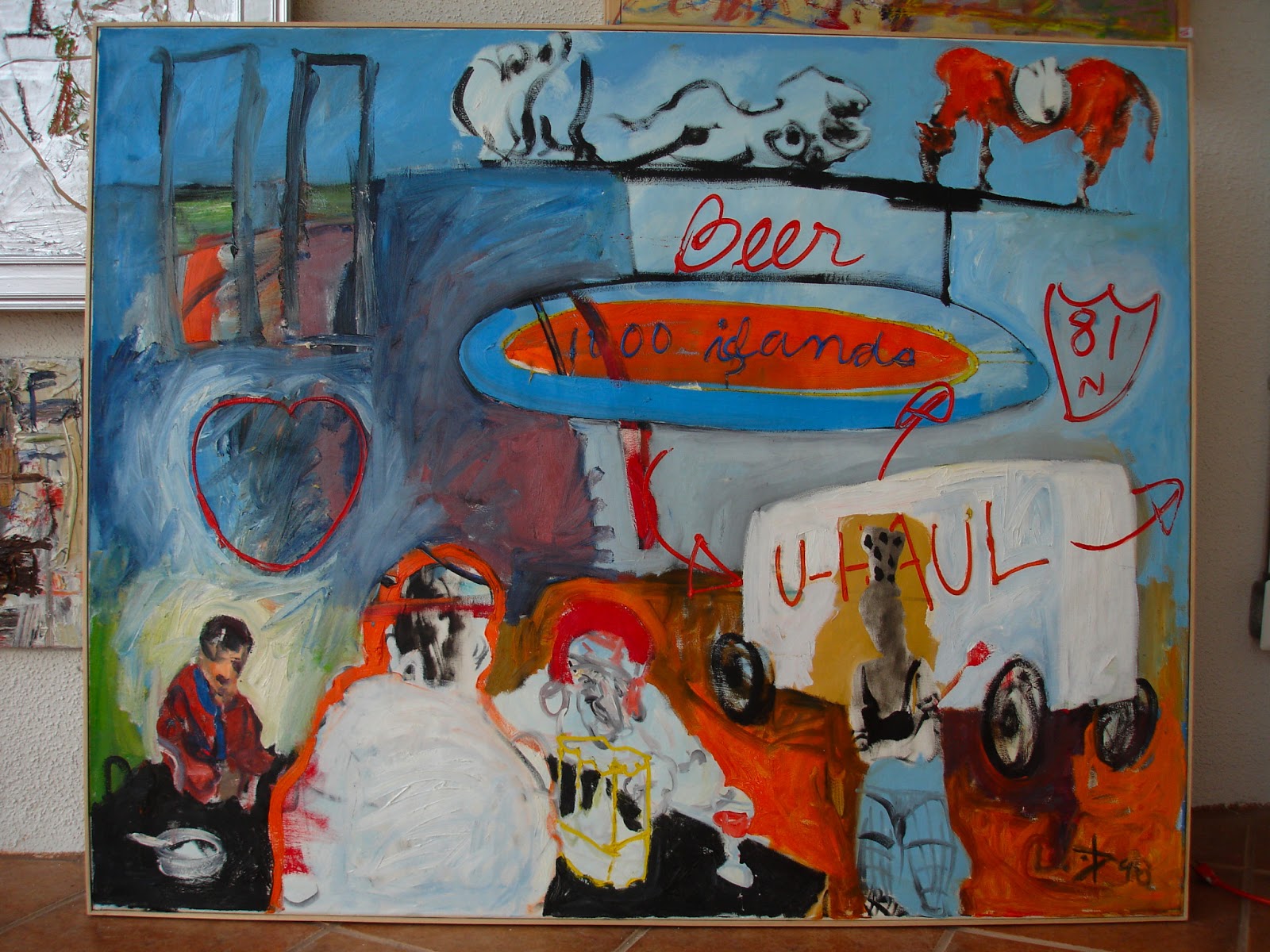
Painting by Peter Fowler. circa 2007.

What is the working title of the book?

As I was writing it, it was entitled “To Becoming Normal”.  Since its completion, it carries the title “A Normal Line of Work”.

Where did the idea come from for the book?

I had hit on a measure (for the line of the poem) that I found endlessly creative and beautiful. Writing with this form was for me a very distinct and productive experience, and I was almost always surprised and pleased by the results. So, to be brief, the idea came from my writing of poetry over all the years previous to it.

What genre does your book fall under?

It is a poem, a long poem. I amused myself with a new label at the time: literary pointillism. Something radical, integral, but clearly just a drop in the bucket.

What actors would you choose to play the part of your characters in a movie rendition?

I would choose the first group of people who could stage it, if each actor took a section and commited it to memory.  There needs to be an instrumental component, but outside of ballads and what I consider pop music, I am not a composer. I know it has performance potential since it was best realized as a theater, or performance, event back in 2008. But it is a book.

I like Alec Guinness a lot, and James Stewart, Harriet Andersson, Julie Christie. I’m not quite up to date on A-list actors. Why don’t you ask who I’d like to make the movie?

What is the one sentence synopsis of your book?

“A Normal Line of Work” is a long poem-as-score for musical and theatrical performance, coordinated between the extremes of pure music and recitation.

How long did it take to write the first draft of the manuscript?

Three years.

Who or what inspired you to write this book?

Poets—early companions—Major Ragain, Alice Cone, Kathy Korcheck, Jayce Renner, Adam Brodsky (the Cleveland poet, not the anti-folk guy), then purely historical sources—Kenneth Patchen, bpNichol, and so on—hundreds of poets I heard at readings before I quit the scene—I guess those who provided me the space and time to work as a poet for as long as I did with such concentration (sadly, I do currently work at that level)—the poetics program at Buffalo: Robert Creeley, Susan Howe, Charles Bernstein, Dennis Tedlock, those I worked alongside—Michael Basinski, Kristianne Meal, Jonathan Skinner, many many others. Though my writing process and aims were, in my view, vastly different than his, the master then and now of the short line is Tom Raworth—this was made clear to me only when the book was nearly finished. All the best poets I read and listened to understood this kind of weighting of sound and silence, textual space and writing. But I was continually inspired by friends and loved ones who supported me as a poet in Buffalo.

What else about your book might pique the reader’s interest?

We might wonder if the United States will ever understand the disastrous problems and self-inflicted wounds it faced in the years 2001-2008. Many Americans do seem to recognize the severity of our crisis in some places, but too many continue on in ignorance of chronic inequalities and injustices in many others. I think my choice to work and live as a poet at that time was either ridiculously foolish or uncommonly brave, depending. Poets, for good or ill, are tuned to completely unexpected ranges of impression, and in writing my poem at the level of seriousness I then had, I was truly happy to have written the book for what I was learning and able to convey. I haven’t had that assurance since—and once I knew it was done, I didn’t know what was to come next. I don’t know that I’ll be as close to a combined feeling and structuring of music in the line ever again. Because I didn’t know exactly what to do with it—so that it would lead to a further development in my writing—I didn’t travel with it or share it with audiences in any big way. Also, once it was finished, when I saw most supports for myself as a writer crumbling away—both internally and externally—I stopped trying to go on with poetry as my only serious work. I could muddle along as a clerk or marginalized, adjunct professor. The sense of my feeling that poetry was all I had may be in there—the feeling that, while those closest to you accept you and support you, there is a malicious ocean of discouragement awaiting you for sticking to your art without obeying the orders of alternately ignorant, commercial, bureaucratic & totalitarian forces, even in our beloved fine arts communities.  I guess it might pique your interest that I’m not screaming through the flames, I’m trying to live a relatively boring, middle-class life as a poet and performer. The absurdity of that might twit your boutonnière. But look, when even loudmouth poets stop taking poetry seriously as the best of our intellectual and emotional efforts, then what the hell kind of reception will poetry get? You’re probably too busy trying to feed your kids or punching the clock to drift off on my mad trips, anyway.

Will your book be self-published or represented by an agency?

What a great question. I saw in another magazine the question “Paper or plastic?” put to an author—are you an ideologue of print or digital? Ha ha. I was making laser-printed, stapled chapbooks at the time I was writing “A Normal Line of Work”. I had a poetry press. It would be nice if my poem were in a book that someone could check out of the library or buy in a store, that Small Press Distribution could send to someone if he or she ordered it, or that I could send out if it was ordered from me. I know now that I am much better off just working on my writing, rather than trying to handle the manufacturing or publicity end of things, trying to wedge it into people’s brains. If there are any publishers who like the idea of making a beautiful, printed volume better than keeping a balanced budget, they’re welcome to contact me and we can set it up as a project. The poem is also somewhere on this blog, under the title “A Long Poem,” but it really belongs in a book. I’d love to perform it again, with my jar of honey, the stamp-pad tattoos, the guitars and all the interruptions, ‘at any point’.

Sunday, February 17, 2013

The Unused Blog Takes on Spam

While I rarely use this blog, I do keep it around for sentimental reasons. A mark of a time. A time of marked activity. It was an active blog, but not a very well-remarked blog. I eventually realized it was eighty parts personal vanity, and twenty parts a contribution to the written art, and a source for critical, personal and miscellaneous notes on life. It persisted as an activity for me for a number of years--perhaps Facebook took over whatever hole of need it was filling for me. Since I rarely blog, I have been getting enormous amounts of spam posts, and I wish Google could identify spam more rigorously, so that it doesn't seem like my blog is haunting me through my email account. It is not a haunted blog, but a kind of electronic home.I care enough about it to not let it fill with useless garbage, scams, and hawkers of less than nothing--hawkers of digital harm, in my opinion.

Thursday, January 3, 2013

Blogging

Perhaps one day I will blog again. Though the demand is just a whisp of a notion, an afterthought.

Monday, August 6, 2012

I miss the days of blogging as a fine art. I mean, when blogging was part of the work I considered important.

Sunday, April 15, 2012

Caudal Chords, Axial Cords

I realize that my friend never gets lost, and though I insist that we are heading in the right direction, I inevitably turn out to be wrong. What patience my friend must have, to again and again follow me down the wrong street and not speak a word. And it sucks to know how often I have to rely on my friend’s judgment about directions, urban and intellectual, as I try, each and every day, to make my way, worrying about cul-de-sacs, blind alleys, short piers and lost roads. I'm heading for it.


Friday, February 17, 2012

Hi Blog

Hello.

Tonight is cool, the weather is clear.

Wednesday, November 16, 2011

Saturday, November 5, 2011


Preference has been moved to increase discoverability. Susceptible to giant news camera + million-dollar blonde in the bougie chelsea market I hold this slateboard as if holding my magical member cupped in hand at my crotch on the train where the trimmings and trappings of power provoke a kind of mental armoring. The news camera beckons me, as does the million-dollar blonde, while a plain Jane next to her shapes the discourse = budget and teachers in Mayor Bloomers flower patch. Lots of giant and crawling cameras here atop the highline park. Views, views, views. The iron spikey mental cardio shell of my emotional consistency means you, Mr. Bossy Commuter should not box me out like it's all basketball; and you, young reader with maedchen frills should let me lick your stomach like it was an unnecessarily rough-wrapped extra nice ice cream cone because I like you bunches and want to hear your pleasure soaked voice. Your freckles can only say so much while our tongues are so versatile here in late June, my j-june Janey. Loan me your interest and give me outright your affections and I'll read your hip back to you--what does it say..."Save Our Ships"? Don't expect magical budgetary manipulations to miraculously ameliorate the pitfall of this, the Whole Fucking Rented World.


*.*
photos by & rights held by Douglas Manson

Saturday, October 15, 2011

Poem

fondle and pull
recollections of a lonely wanderer
from a rotting bog of garbage
earnestly

the thinness of life
in consumerist complicity
well wish
hole in the chest
anger
books & space
weakness
thinking and forgetting
tiny cycle
small wisps around
the nerves of the brain
or whips
canned food
dry feature
compulsive
smoking
monitoring
Tuesday aubade
electric light
coffee & the men and women
who grew it, picked it
got it here

form foam
cartoon
cat and mouse and dog
and history
to be interested

the international phonetic alphabet
cultures and nations
living in temperate rain forests
and the ocean
rain

walking and getting wet
no longer having heart attacks
on a train, but thinking only of my book,
its words.
i used to look around searching faces
(as I do at my home
personalized computer society

mass arrests on the Brooklyn Bridge

Tuesday
October
cheese and beans
breath and hole in chest
the last barrier is
this red pouch I roll from

big black boots
boring clothes

I think about her every day.

*.*

Monday, August 8, 2011

5th Annual Welcome to Boog City Festival

Scenes from the 8th Annual Small, Small Press Fair. August 6, 2011.

sunny.
august.
hot.

Evie Shockley reading from her chapbook of prose poems (Belladonna*, 2010). She also read from her new book The New Black (Weslyan, 2011).

Leigh Stein reads from her sheets and keeps the crowd in stitches.


Magus Magnus exponentializes his Heraclitean Pride (Furniture Press).


Helen Vitoria reads her poems. Sunglasses looks on.


Don Saddles' Francesca Capone played us the recipes of Cariah Lily Rosberg, featuring a kind of ice cream that includes cheap, raw meat and lentils.


After drying my tears, Brenda Ijima sent an attentive hush across all of Brooklyn with her poems from Glossematics (Least Weasel, 2011). Least Weasel chapbooks are letterpress masterpieces, made from the finest materials known to man.


Stephanie Gray reads her work from the new issue of Aufgabe (#10).


Rumor has it that Joe Elliot does all of his son's Homework (Chandelier Press, 2010).


Poetry in the garden courtyard of Unnameable Books.

On my way home through Prospect Park, I saw a young woman on a bicycle careening wildly across the Long Meadow, and was startled when the front wheel of her bicycle suddenly bent under her, and she flew longwise from her perch. I rushed over, and found her lying senseless in the grass.


After applying the gentlest of my healing arts to her most tender parts, she made a full, happy recovery.


"My hero!" she sighed.

*.*


Sunday, July 31, 2011

Scenes from the First Annual New York Poetry Festival

July 30th & 31st. Governors Island, New York City

Quod si me lyricis vatibus inseres
Sublimi feriam sidere capite

Note: video quality seems choppy on my machine, and is best viewed with the audio turned off.


Brooklyn Ferry to Governors Island from Pier 6 from Douglas Manson on Vimeo.

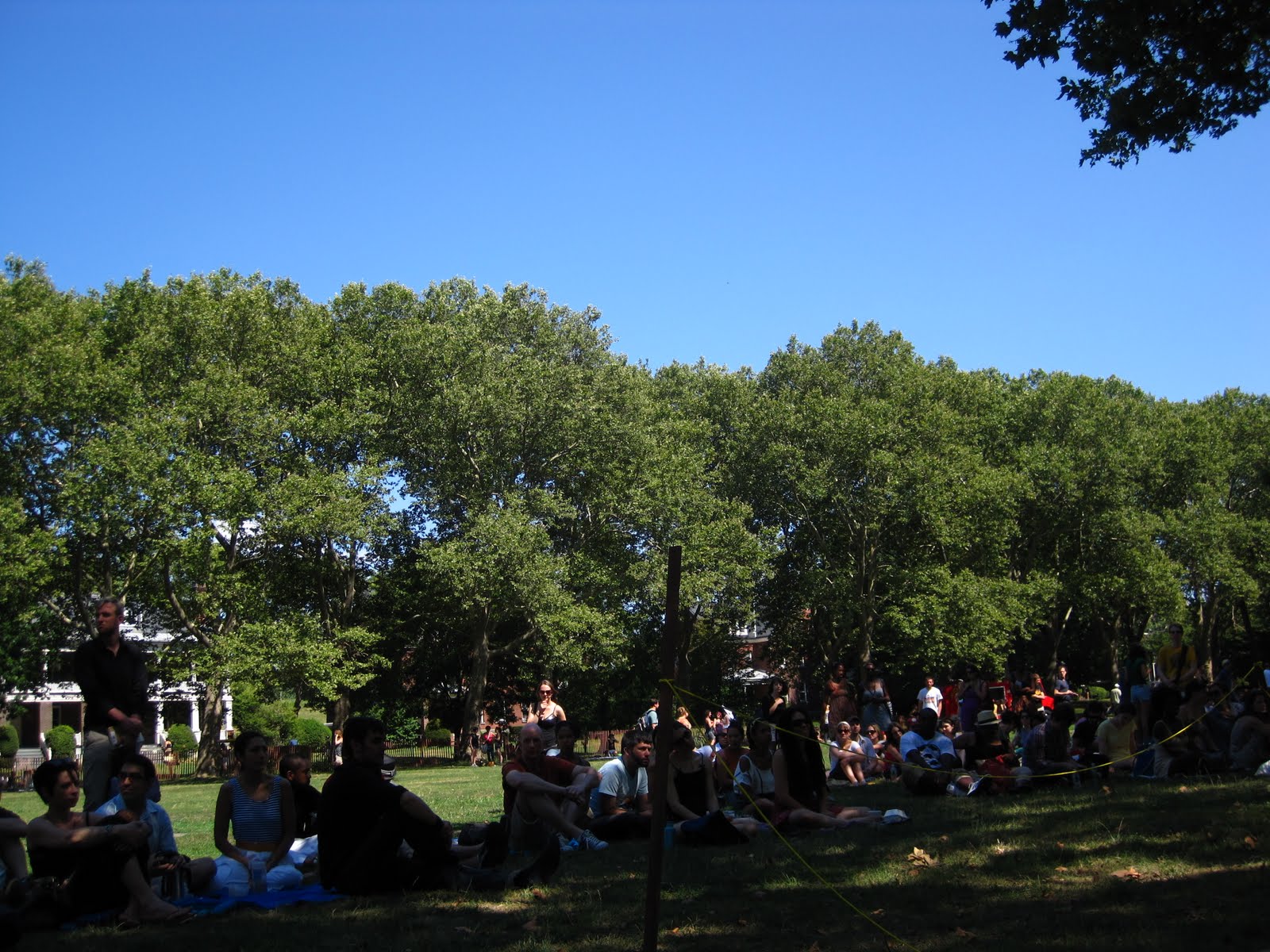
The Ferry ride is quick, but fun. The readings were held along the beautiful & stately Colonel's Row, under a colonnade of ample, lush sycamores.


I spent most of my time at the Admiral's Stage, and heard poets from FOU magazine, No, Dear and the Southern Writers Reading Series.

Here was the first great MC at the festival. Please help me identify some of these presenters and poets!


The first poet was Claire Donato. She's a great poet:


"The kindest poet lives alone." She intoned. She insisted.

Next up was Cynthia Arrieu-King:


Great poet and owner of Berl's Brooklyn Poetry Shop, Farrah Field read next:


Happy to provide gender equality was the wonderful Chris Martin:


Next was a poet, whose name I missed:


I then heard poets from the Southern Writers Reading Series. Author of Painkiller, Patricia Spears Jones raised the volume!


"SAY IT LOUD!"

Just before I was drawn away by the siren song of the Poetry Whores at the nearby brothel, I heard the distinct cadences of the well-received Yusef Komunyakaa, whose most recent collection is The Chameleon Couch (Farrar, Strauss, Giroux, 2011):


At one point, thrown off his line by the booming PA sounds from the nearby "Brigadier" stage, he smiled and asked "How does this work?" I'm not sure he heard me, but I responded, "It doesn't!" Usually the sound systems worked quite well, but at times one heard a kind of mixed combination of lines from different stages, that was sometimes interesting, but usually disruptive. I stood directly between the two stages once and tried to find a point of dialogue, which worked for a few moments as two poets read, but then found it less exciting than it could have been. Perhaps more coordinated presentations of "naval word battle" could extend the dramatic possibilities of holding simultaneous readings. Too bad there weren't some semaphore poems in the mix. My two cents.

It was all free, in an amazing place, on one of the most beautiful days we've had this summer. If you see this in time, go out today (31 July) and check it out! Take water and food with you, though great food and drink were available for purchase. Please support the poets! This is an event to look forward to in coming years. Where O where were you, Boo-Boo??????? Zoom-zoom???


*.*

Wednesday, July 13, 2011

If You'd Only Known / It's Hid From Your Eyes

Hör auf Mich un Conseil

Focus constantly to make your work
a celebration of the joys of human existence.
Trace the lives and live the traces
of all that surrounds you.
Notice children first and see
in their eyes the world is small,
smaller than the mile in which they move,
the smaller circle of a parent’s hand
more alive than a thought that revolves
& devolves on the edge of pluto's ellipse
or such men who calculate by millions,
pretend visions in heaps of this
& hillocks of that.

Find that each person is innately kind,
& anger is sudden confusion.
Despair is only a longing
for impossible wealth or threats
which cannot present themselves to be realized.
Pain comes with only knowing what is seen.
Comprehension of everything is a pain
created out of false consciousness,
laying your mental history upon objects
unaware of your calculation.
Chaos creeps on the edge of such knowledge
and cracks the foundation of all
that is supposed to be true.
There is a wilder truth
that the mind cannot overcome
once the eye beholds it.

Trust your senses, for they do not lie.

Sun Solo from Douglas Manson on Vimeo.


*.*

Wednesday, June 29, 2011

Americans Aren't Going Out to Get New Stuff as Much as They Used To

We are erogenous and emotional nomads who refuse history as bad conscience, and memory as mental detritus. We are determined, each one of us, to learn all the functional skills necessary to have a life rich in experiences, give and take pleasures by way of our demonstrations of mastery over all kinds of things--ordering food and settling bills and shopping and planning fun-filled adventurous trips across the country, meeting new people and having stimulating and refreshing conversations about topics that are really new and important and cool, turning each other on to new ideas and music and spiritual paradises awaiting them in the lifelong study and accumulation of knowledge that can be eventually packaged into a tiny pill you just pop right into your mouth and there it is, unfolding all-in-all across the canyons and mesas of your brain: someone's life work conveniently condensed and formatted for the instantaneous enjoyment up and down and in and out of the fine diamond-strewn lines and paths of your otherwise overstressed and tangled neural weave. POP!

*.*

Saturday, June 18, 2011

a reading of new poetry and fiction

Jibade-Khalil Huffman
Douglas Manson
Molly Prentiss
Nancy Weber

Soul Cafe at The Lutheran Church of the Good Shepherd
7420 Fourth Avenue, Bay Ridge, Brooklyn

Time: ‎7:30PM Friday, June 24th, 2011

Jibade-Khalil Huffman is the author of "19 Names For Our Band" (Fence Books, 2008) and "James Brown is Dead" (Future Plan and Program/Project Row Houses, 2011). His works of art and writing have been exhibited and performed at MoMA/PS1, the Museum of Arts and Design in New York and Eighth Veil gallery in Los Angeles, among others. He was a 2010-2011 Workspace Artist-in-Residence with the Lower Manhattan Cultural Council.


Douglas Manson is a poet living in Bay Ridge, Brooklyn. He is the author of the poetry collection Roofing and Siding and a long poem A Normal Line of Work. He teaches writing at LaGuardia Community College. He holds a PhD from the Buffalo Poetics Program, and writes essays, art reviews and a blog.


Molly Prentiss received an MFA in Creative Writing at the California College of the Arts and is now a resident writer at the Lower Manhattan Cultural Council. She has been published in Fourteen Hills, Switchback, La Petite Zine, The Furnace Review, Miracle Monocle & Staccato Fiction and has forthcoming pieces in We Still Like and Mud Luscious. Her writings and drawings can be found at mollyprentiss.blogspot.com.


Nancy Weber’s work can be found in Evergreen Review, Dicey Brown, VerbSap, Fringe Magazine and the Brooklyn Rail. She was a 2007 recipient of a full Fellowship to the Vermont Studio Center Writer’s Residency Program. She is the Youth Program Director at the NY Writers Coalition, and lives and writes in Brooklyn.


*.*


Sunday, April 24, 2011

"Easter in New York" by Blaise Cendrars, 1912.


Pâques à New York


Seigneur, c'est aujourd'hui le jour de votre Nom,
J'ai lu dans un vieux livre la geste de votre Passion
Et votre angoisse et vos efforts et vos bonnes paroles
Qui pleurent dans un livre, doucement monotones.
Un moine d'un vieux temps me parle de votre mort.
Il traçait votre histoire avec des lettres d'or
Dans un missel, posé sur ses genoux,
Il travaillait pieusement en s'inspirant de Vous.
A l'abri de l'autel, assis dans sa robe blanche,
Il travaillait lentement du lundi au dimanche.
Les heures s'arrêtaient au seuil de son retrait.
Lui, s'oubliait, penché sur votre portrait.
A vêpres, quand les cloches psalmodiaient dans la tour,
Le bon frère ne savait si c'était son amour
Ou si c'était le Vôtre, Seigneur, ou votre Père
Qui battait à grands coups les portes du monastère.
Je suis comme ce bon moine, ce soir, je suis inquiet.
Dans la chambre à côté, un être triste et muet
Attend derrière la porte, attend que je l'appelle !
C'est Vous, c'est Dieu, c'est moi, - c'est l'Eternel.
Je ne Vous ai pas connu alors, - ni maintenant.
Je n'ai jamais prié quand j'étais un petit enfant.
Ce soir pourtant je pense à Vous avec effroi.
Mon âme est une veuve en deuil au pied de votre Croix ;
Mon âme est une veuve en noir, - c'est votre Mère
Sans larme et sans espoir, comme l'a peinte Carrière.


Je connais tous les Christs qui pensent dans les musées ;
Mais Vous marchez, Seigneur, ce soir à mes côtés.
Je descends à grands pas vers le bas de la ville,
Le dos voûté, le coeur ridé, l'esprit fébrile.
Votre flanc grand-ouvert est comme un grand soleil
Et vos mains tout autour palpitent d'étincelles.
Les vitres des maisons sont toutes pleines de sang
Et les femmes, derrière, sont comme des fleurs de sang,
D'étranges mauvaises fleurs flétries, des orchidées,
Calices renversés ouvert sous vos trois plaies.
Votre sang recueilli, elles ne l'ont jamais bu.
Elles ont du rouge aux lèvres et des dentelles au cul.
Les fleurs de la passion sont blanches comme des cierges,
Ce sont les plus douces fleurs au Jardin de la Bonne Vierge.
C'est à cette heure-ci, c'est vers la neuvième heure
Que votre tête, Seigneur, tomba sur votre Coeur.
Je suis assis au bord de l'océan
Et je me remémore un cantique allemand,
Où il est dit, avec des mots très doux, très simples, très purs,
La beauté de votre Face dans la torture.
Dans une église, à Sienne, dans un caveau,
J'ai vu la même Face, au mur, sous un rideau.
Et dans un ermitage, à Bourrié-Wladislasz,
Elle est bossuée d'or dans une châsse.
De troubles cabochons sont à la place des yeux
Et des paysans baisent à genoux Vos yeux.
Sur le mouchoir de Véronique Elle est empreinte
Et c'est pourquoi Sainte Véronique est votre sainte.
C'est la meilleure relique promenée par les champs,
Elle guérit tous les malades, tous les méchants.
Elle fait encore mille et mille autres miracles,
Mais je n'ai jamais assisté à ce spectacle.
Peut-être que la foi me manque, Seigneur, et la bonté
Pour voir ce rayonnement de votre Beauté.
Pourtant, Seigneur, j'ai fait un périlleux voyage
Pour contempler dans un béryl l'intaille de votre image.
Faites, Seigneur, que mon visage appuyé dans les mains
Y laisse tomber le masque d'angoisse qui m'étreint.
Faites, Seigneur, que mes deux mains appuyées sur ma bouche
N'y lèchent pas l'écume d'un désespoir farouche.
Je suis triste et malade. Peut-être à cause de Vous,
Peut-être à cause d'un autre. Peut-être à cause de Vous.
Seigneur, la foule des pauvres pour qui vous fîtes le Sacrifice
Est ici, parquée, tassée, comme du bétail, dans les hospices.
D'immenses bateaux noirs viennent des horizons
Et les débarquent, pêle-mêle, sur les pontons.
Il y a des Italiens, des Grecs, des Espagnols,
Des Russes, des Bulgares, de Persans, des Mongols.
Ce sont des bêtes de cirque qui sautent les méridiens.
On leur jette un morceau de viande noire, comme à des chiens.
C'est leur bonheur à eux que cette sale pitance.
Seigneur, ayez pitié des peuples en souffrance.
Seigneur, dans le ghetto, grouille la tourbe des Juifs
Ils viennent de Pologne et sont tous fugitifs.
Je le sais bien, ils ont fait ton Procès ;
Mais je t'assure, ils ne sont pas tout à fait mauvais.
Ils sont dans des boutiques sous des lampes de cuivre,
Vendent des vieux habits, des armes et des livres.
Rembrandt aimait beaucoup les peindre dans leurs défroques.
Moi, j'ai ce soir marchandé un microscope.
Hélas! Seigneur, Vous ne serez plus là, après Pâques !
Seigneur, ayez pitié des Juifs dans les baraques.
Seigneur, les humbles femmes qui vous accompagnèrent à Golgotha
Se cachent. Au fond des bouges, sur d'immondes sophas,
Elles sont polluées de la misère des hommes.


Des chiens leur ont rongé les os, et dans le rhum
Elles cachent leur vice endurci qui s'écaille.
Seigneur, quand une de ces femmes parle, je défaille.
Je voudrais être Vous pour aimer les prostituées.
Seigneur, ayez pitié des prostituées.
Seigneur, je suis dans le quartier des bons voleurs,
Des vagabonds, des va-nu-pieds, des recéleurs.
Je pense aux deux larrons qui étaient avec vous à la Potence,
Je sais que vous daignez sourire à leur malchance.
Seigneur, l'un voudrait une corde avec un noeud au bout,
Mais ça n'est pas gratis, la corde, ça coûte vingt sous.
Il raisonnait comme un philosophe, ce vieux bandit.
Je lui ai donné de l'opium pour qu'il aille plus vite en paradis.
Je pense aussi aux musiciens des rues,
Au violoniste aveugle, au manchot qui tourne l'orgue de Barbarie,
A la chanteuse au chapeau de paille avec des roses de papier ;
Je sais que ce sont eux qui chantent durant l'éternité.
Seigneur, faites-leur l'aumône, autre que de la lueur des becs de gaz,
Seigneur, faites-leur l'aumône de gros sous ici-bas.
Seigneur, quand vous mourûtes, le rideau se fendit,
Ce qu'on vit derrière, personne ne l'a dit.
La rue est dans la nuit comme une déchirure
Pleine d'or et de sang, de feu et d'épluchures.
Ceux que vous avez chassé du temple avec votre fouet,
Flagellent les passants d'une poignée de méfaits.
L'Etoile qui disparut alors du tabernacle,
Brûle sur les murs dans la lumière crue des spectacles.
Seigneur, la Banque illuminée est comme un coffre-fort,
Où s'est coagulé le Sang de votre mort.
Les rues se font désertes et deviennent plus noires.
Je chancelle comme un homme ivre sur les trottoirs.
J'ai peur des grands pans d'ombre que les maisons projettent.
j'ai peur. Quelqu'un me suit. Je n'ose tourner la tête.
Un pas clopin-clopant saute de plus en plus près.
J'ai peur. J'ai le vertige. Et je m'arrête exprès.
Un effroyable drôle m'a jeté un regard
Aigu, puis a passé, mauvais comme un poignard.
Seigneur, rien n'a changé depuis que vous n'êtes plus Roi.
Le mal s'est fait une béquille de votre Croix.
Je descends les mauvaises marches d'un café
Et me voici, assis, devant un verre de thé.
Je suis chez des Chinois, qui comme avec le dos
Sourient, se penchent et sont polis comme des magots.
La boutique est petite, badigeonnée de rouge
Et de curieux chromos sont encadrés dans du bambou.
Ho-Koussaï a peint les cent aspects d'une montagne.
Que serait votre Face peinte par un Chinois?


Cette dernière idée, Seigneur, m'a d'abord fait sourire.
Je vous voyais en raccourci dans votre martyre.
Mais le peintre pourtant, aurait peint votre tourment
Avec plus de cruauté que nos peintres d'Occident.
Des lames contournées auraient scié vos chairs,
Des pinces et des peignes auraient strié vos nerfs,
On vous aurait passé le col dans un carcan,
On vous aurait arraché les ongles et les dents,
D'immenses dragons noirs se seraient jetés sur Vous,
Et vous auraient soufflé des flammes dans le cou,
On vous aurait arraché la langue et les yeux,
On vous aurait empalé sur un pieu.
Ainsi, Seigneur, vous auriez souffert toute l'infamie,
Car il n'y a pas plus cruelle posture.
Ensuite, on vous aurait forjeté aux pourceaux
Qui vous auraient rongé le ventre et les boyaux.
Je suis seul à présent, les autres sont sortis,
Je suis étendu sur un banc contre le mur.
J'aurais voulu entrer, Seigneur, dans une église ;
Mais il n'y a pas de cloches, Seigneur, dans cette ville.
Je pense aux cloches tues : - où sont les cloches anciennes ?
Où sont les litanies et les douces antiennes ?
Où sont les longs offices et où les beaux cantiques ?
Où sont les liturgies et les musiques ?
Où sont les fiers prélats, Seigneur, où tes nonnains ?
Où l'aube blanche, l'amict des Saintes et des Saints ?
La joie du Paradis se noie dans la poussière,
Les feux mystiques ne rutilent plus dans les verrières.
L'aube tarde à venir, et dans le bouge étroit
Des ombres crucifiées agonisent aux parois.
C'est comme un Golgotha de nuit dans un miroir
Que l'on voit trembloter en rouge sur du noir.
La fumée, sous la lampe, est comme un linge déteint
Qui tourne, entortillé, tout autour de vos reins.
Par au-dessus, la lampe pâle est suspendue,
Comme votre Tête, triste et morte et exsangue.
Des reflets insolites palpitent sur les vitres ...
J'ai peur, - et je suis triste, Seigneur, d'être si triste.
"Dic nobis, Maria, quid vidisti in via ?"
- La lumière frissonner, humble dans le matin.
"Dic nobis, Maria, quid vidisti in via ?"
- Des blancheurs éperdues palpiter comme des mains.
"Dic nobis, Maria, quid vidisti in via ?"
- L'augure du printemps tressaillir dans mon sein.
Seigneur, l'aube a glissé froide comme un suaire
Et a mis tout à nu les gratte-ciel dans les airs.
Déjà un bruit immense retentit sur la ville.
Déjà les trains bondissent, grondent et défilent.
Les métropolitains roulent et tonnent sous terre.
Les ponts sont secoués par les chemins de fer.
La cité tremble. Des cris, du feu et des fumées,
Des sirènes à vapeur rauques comme des huées.
Une foule enfiévrée par les sueurs de l'or
Se bouscule et s'engouffre dans de longs corridors.
Trouble, dans le fouillis empanaché de toits,
Le soleil, c'est votre Face souillée par les crachats.
Seigneur, je rentre fatigué, seul et très morne ...
Ma chambre est nue comme un tombeau ...
Seigneur, je suis tout seul et j'ai la fièvre ...
Mon lit est froid comme un cercueil ...
Seigneur, je ferme les yeux et je claque des dents ...
Je suis trop seul. J'ai froid. Je vous appelle ...
Cent mille toupies tournoient devant me yeux ...
Non, cent mille femmes ... Non, cent mille violoncelles ...
Je pense, Seigneur, à mes heures malheureuses ...
Je pense, Seigneur, à mes heures en allées ...
Je ne pense plus à Vous. Je ne pense plus à Vous.


*.*

All text and images used here without permission.

Photo of Blaise Cendrars (1887-1961) born Frederic Louis Sauser.

Paintings by
Eugène Carrière, symbolist painter (1849-1906): Christ on the Cross, Musée des Beaux-Arts, Dijon (?); L'aurore, National Museum of Wales, Cardiff (?); La jeune mere, Musee Calvet, Avignon.

Wood Block print by
Hokusai (1760-1849) Travellers Crossing the Oi River.