Monday, July 29, 2013
I enjoyed the New York City Poetry Festival for 2013
I had fun wandering around and hearing poems coming towards me from all directions. That's a true New York way to do things: go at your target from every conceivable direction. I heard many good poems. The day was sunny and hot, and I didn't bring enough money for the food trucks. I'm not going to write an essay or review about my experience, but I was happy to read a few poems, "Cousin" which is a poem as a letter to a famous (dead) American poet, "Summer Song" which is about love and apocalyptic movies, and "The Materiality of the Signifier" which is about what it is about.


Friday, June 14, 2013
The Golden Treasury by Francis Turner Palgrave
#72, Elizabethan poem by Henry Wotton--
Character of a Happy Life
How happy is he born and taught
That serveth not another's will;
Whose armor is his honest thought
And simple truth his utmost skill;
Whose passions not his masters are;
Whose soul is still prepared for death,
Not tied unto the world with care
Of public fame, or private breath;
Who envies none that chance doth raise,
Or vice; who never understood
How deepest wounds are given by praise,
Nor rules of state, but rules of good;
Who hath his life from rumors freed,
Whose conscience is his strong retreat;
Whose state can neither flatterers feed,
Nor ruin make accusers great;
Who God doth late and early pray
More of his grace than gifts to lend;
And entertains the harmless day
With a well-chosen book or friend;
--This man is freed from servile bands
Of hope to rise, or fear to fall;
Lord of himself, though not of lands;
And having nothing, yet hath all.
Wikipedia tells us this about our author:
Sir Henry Wotton (30 March 1568 – December 1639) was an English author, diplomat and politician who sat in the House of Commons in 1614 and 1625. He is often quoted as saying, "An ambassador is an honest gentleman sent to lie abroad for the good of his country." (he is said to have stated this while on a mission in Augsburg, in 1604.)
Character of a Happy Life
How happy is he born and taught
That serveth not another's will;
Whose armor is his honest thought
And simple truth his utmost skill;
Whose passions not his masters are;
Whose soul is still prepared for death,
Not tied unto the world with care
Of public fame, or private breath;
Who envies none that chance doth raise,
Or vice; who never understood
How deepest wounds are given by praise,
Nor rules of state, but rules of good;
Who hath his life from rumors freed,
Whose conscience is his strong retreat;
Whose state can neither flatterers feed,
Nor ruin make accusers great;
Who God doth late and early pray
More of his grace than gifts to lend;
And entertains the harmless day
With a well-chosen book or friend;
--This man is freed from servile bands
Of hope to rise, or fear to fall;
Lord of himself, though not of lands;
And having nothing, yet hath all.
Wikipedia tells us this about our author:
Sir Henry Wotton (30 March 1568 – December 1639) was an English author, diplomat and politician who sat in the House of Commons in 1614 and 1625. He is often quoted as saying, "An ambassador is an honest gentleman sent to lie abroad for the good of his country." (he is said to have stated this while on a mission in Augsburg, in 1604.)
Wednesday, March 13, 2013
The Next Big Thing Questionnaire
Poet and ecologist E.J. McAdams tagged me to answer:

What a great question. I saw in another magazine the question “Paper or
plastic?” put to an author—are you an ideologue of print or digital? Ha ha. I
was making laser-printed, stapled chapbooks at the time I was writing “A Normal
Line of Work”. I had a poetry press. It would be nice if my poem were in a book
that someone could check out of the library or buy in a store, that Small Press
Distribution could send to someone if he or she ordered it, or that I could
send out if it was ordered from me. I know now that I am much better off just
working on my writing, rather than trying to handle the manufacturing or
publicity end of things, trying to wedge it into people’s brains. If there are
any publishers who like the idea of making a beautiful, printed volume better
than keeping a balanced budget, they’re welcome to contact me and we can set it
up as a project. The poem is also somewhere on this blog, under the title “A
Long Poem,” but it really belongs in a book. I’d love to perform it again, with
my jar of honey, the stamp-pad tattoos, the guitars and all the interruptions,
‘at any point’.
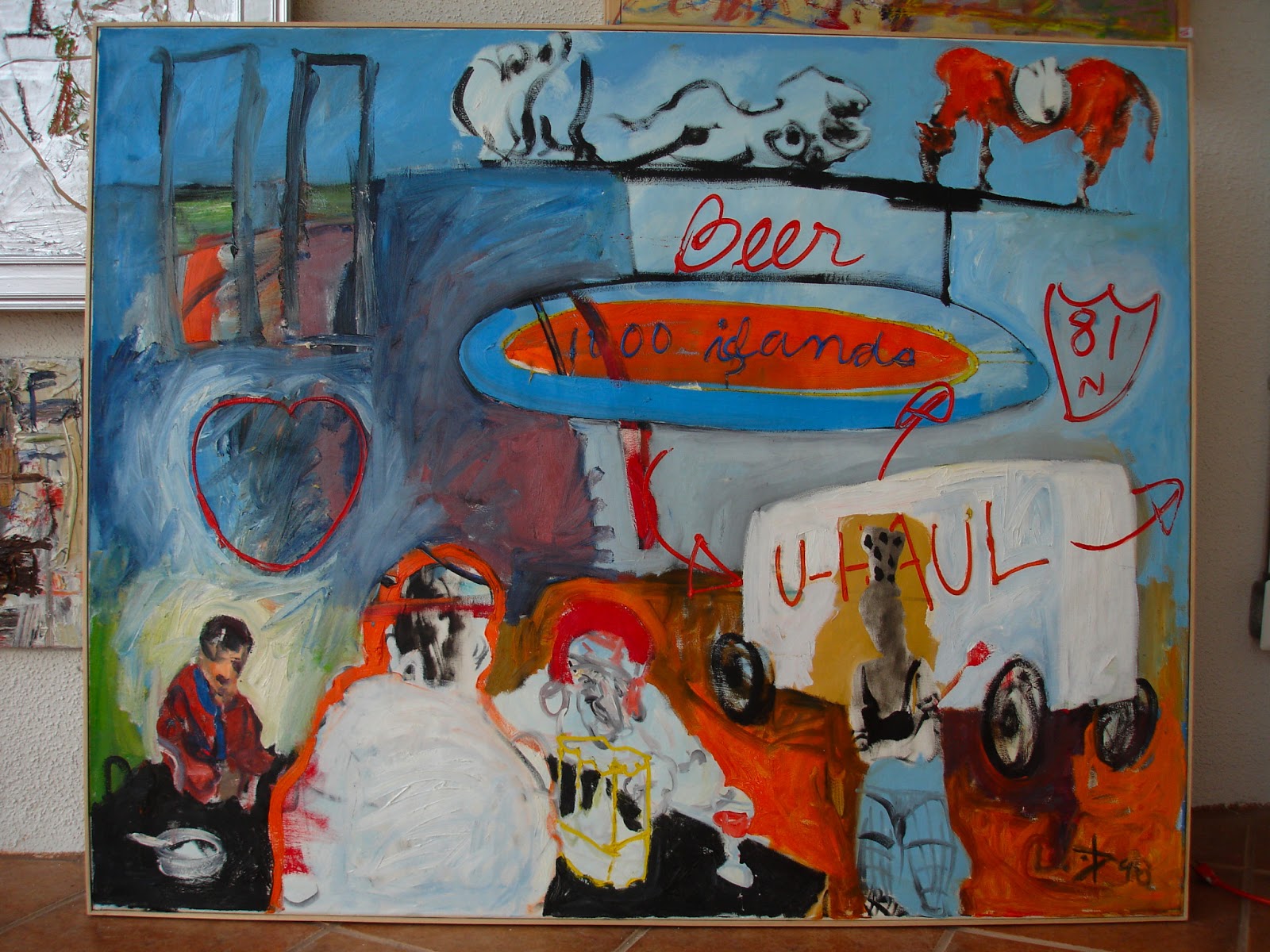
Painting by Peter Fowler. circa 2007.
What is the working title of the book?
As I was writing it, it was entitled “To Becoming Normal”.
Since its completion, it carries the title “A Normal Line of Work”.
Where did the idea come from for the book?
I had hit on a measure (for the line of the poem) that I
found endlessly creative and beautiful. Writing with this form was for me a
very distinct and productive experience, and I was almost always surprised and
pleased by the results. So, to be brief, the idea came from my writing of
poetry over all the years previous to it.
What genre does your book fall under?
It is a poem, a long poem. I amused myself with a new
label at the time: literary pointillism. Something radical, integral, but
clearly just a drop in the bucket.
What actors would you choose to play the part of your
characters in a movie rendition?
I would choose the first group of people who could stage
it, if each actor took a section and commited it to memory. There needs to be an instrumental
component, but outside of ballads and what I consider pop music, I am not a
composer. I know it has performance potential since it was best realized as a
theater, or performance, event back in 2008. But it is a book.
I like Alec Guinness a lot, and James Stewart, Harriet
Andersson, Julie Christie. I’m not quite up to date on A-list actors. Why don’t
you ask who I’d like to make the movie?
What is the one sentence synopsis of your book?
“A Normal Line of Work” is a long poem-as-score for
musical and theatrical performance, coordinated between the extremes of pure
music and recitation.
How long did it take to write the first draft of the
manuscript?
Three years.
Who or what inspired you to write this book?
Poets—early companions—Major Ragain, Alice Cone, Kathy
Korcheck, Jayce Renner, Adam Brodsky (the Cleveland poet, not the anti-folk
guy), then purely historical sources—Kenneth Patchen, bpNichol, and so
on—hundreds of poets I heard at readings before I quit the scene—I guess those
who provided me the space and time to work as a poet for as long as I did with
such concentration (sadly, I do currently work at that level)—the poetics
program at Buffalo: Robert Creeley, Susan Howe, Charles Bernstein, Dennis
Tedlock, those I worked alongside—Michael Basinski, Kristianne Meal, Jonathan
Skinner, many many others. Though my writing process and aims were, in my view,
vastly different than his, the master then and now of the short line is Tom
Raworth—this was made clear to me only when the book was nearly finished. All
the best poets I read and listened to understood this kind of weighting of
sound and silence, textual space and writing. But I was continually inspired by
friends and loved ones who supported me as a poet in Buffalo.
What else about your book might pique the reader’s
interest?
We might wonder if the United States will ever understand
the disastrous problems and self-inflicted wounds it faced in the years
2001-2008. Many Americans do seem to recognize the severity of our crisis in
some places, but too many continue on in ignorance of chronic inequalities and
injustices in many others. I think my choice to work and live as a poet at that
time was either ridiculously foolish or uncommonly brave, depending. Poets, for
good or ill, are tuned to completely unexpected ranges of impression, and in
writing my poem at the level of seriousness I then had, I was truly happy to
have written the book for what I was learning and able to convey. I haven’t had
that assurance since—and once I knew it was done, I didn’t know what was to
come next. I don’t know that I’ll be as close to a combined feeling and
structuring of music in the line ever again. Because I didn’t know exactly what
to do with it—so that it would lead to a further development in my writing—I
didn’t travel with it or share it with audiences in any big way. Also, once it
was finished, when I saw most supports for myself as a writer crumbling
away—both internally and externally—I stopped trying to go on with poetry as my
only serious work. I could muddle along as a clerk or marginalized, adjunct
professor. The sense of my feeling that poetry was all I had may be in
there—the feeling that, while those closest to you accept you and support you,
there is a malicious ocean of discouragement awaiting you for sticking to your
art without obeying the orders of alternately ignorant, commercial,
bureaucratic & totalitarian forces, even in our beloved fine arts
communities. I guess it might pique your interest that I’m not screaming
through the flames, I’m trying to live a relatively boring, middle-class life
as a poet and performer. The absurdity of that might twit your boutonnière. But
look, when even loudmouth poets stop taking poetry seriously as the best of our
intellectual and emotional efforts, then what the hell kind of reception will
poetry get? You’re probably too busy trying to feed your kids or punching the
clock to drift off on my mad trips, anyway.
Will your book be self-published or represented by an
agency?
Sunday, February 17, 2013
The Unused Blog Takes on Spam
While I rarely use this blog, I do keep it around for sentimental reasons. A mark of a time. A time of marked activity. It was an active blog, but not a very well-remarked blog. I eventually realized it was eighty parts personal vanity, and twenty parts a contribution to the written art, and a source for critical, personal and miscellaneous notes on life. It persisted as an activity for me for a number of years--perhaps Facebook took over whatever hole of need it was filling for me. Since I rarely blog, I have been getting enormous amounts of spam posts, and I wish Google could identify spam more rigorously, so that it doesn't seem like my blog is haunting me through my email account. It is not a haunted blog, but a kind of electronic home.I care enough about it to not let it fill with useless garbage, scams, and hawkers of less than nothing--hawkers of digital harm, in my opinion.
Thursday, January 3, 2013
Blogging
Perhaps one day I will blog again. Though the demand is just a whisp of a notion, an afterthought.
Monday, August 6, 2012
Sunday, April 15, 2012
Caudal Chords, Axial Cords
I realize that my friend never gets lost, and though I insist that we are heading in the right direction, I inevitably turn out to be wrong. What patience my friend must have, to again and again follow me down the wrong street and not speak a word. And it sucks to know how often I have to rely on my friend’s judgment about directions, urban and intellectual, as I try, each and every day, to make my way, worrying about cul-de-sacs, blind alleys, short piers and lost roads. I'm heading for it.

Subscribe to:
Posts (Atom)